Introducing the Tree of Web3 Wisdom

The Owl
By and The Owl
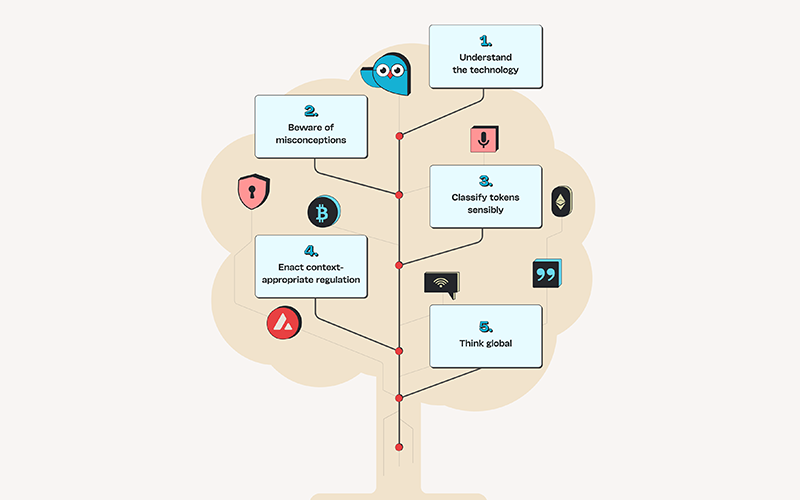
Tree of Web3 Article image

Introducing the Tree of Web3 Wisdom - 5 branches to guide policymaker thinking

The world of Web3 is rapidly evolving, while policymakers keep up with the latest developments to enact effective, sensible regulation that nurtures important technologies and protects consumers.

This is a global phenomenon. Japan continues to update its first-in-the-world comprehensive cryptoasset regulation; Singapore regularly iterates on its regulatory regime, as does South Korea and many small Asian jurisdictions. The EU is on the cusp of implementing its Markets in Crypto-Assets Regulation (MiCA), while various US regulatory agencies continue the work assigned to them in the President’s Executive Order from March 2022. The US Congress is also hard at work with hearings and draft bills.

Against this backdrop, the Tree of Web3 Wisdom provides a helpful framework for understanding the key aspects of Web3 technology and which first principles are important for regulating it. Let's explore the five branches of the Tree of Web3 Wisdom and their implications for policymakers.

The first branch of the tree is to understand the technology. Before regulating Web3, it's essential to have a deep understanding of blockchain technology. Blockchain allows for digital ownership and transfer of value across the internet, with enhanced security, transparency, auditability, programmability, and scale. It also enables users to program on these databases to create applications that are part of a larger tech stack for anything their creativity can imagine. This technology has the potential to empower communities, remove friction, verify credentials, and create new efficiencies in commerce. It's essential for policymakers to understand the capabilities of blockchains and the problems they solve to see the potential benefits and risks involved in its implementation.

The second branch of the tree is to beware of misconceptions. Blockchain technology isn't just about financial transactions. It's a new infrastructure for the internet, providing a decentralized system that promotes transparency and security by having no single point of failure, no single source of truth, and no single entity or authority with the power or obligation to change data or transactions. Crypto assets and blockchain are not synonymous. Blockchains facilitate crypto assets, but they also facilitate many other types of activities by allowing data integrity and digital uniqueness through tokenization. Crypto assets are a way to digitally represent something on a blockchain. 

Decentralized systems promote transparency and security by having no single point of failure, no single source of truth, and no single entity or authority with the power or obligation to change data or transactions. Decentralization does not necessarily mean "permissionless and public," and it is crucial to understand that blockchain technology can be permissioned and private too. DeFi is more than just trading financial instruments–it is an avenue to democratize commercial systems by using blockchains and smart contracts to replace traditional intermediaries with built-in trust mechanisms. NFTs are not just for collectibles and art with revenue streams. An NFT is a type of token that is digitally unique, allowing for more specialized representations regardless of the industry. 

The third branch of the tree is to classify tokens sensibly. A token is a digital representation of something on a blockchain, such as an asset, item, or bundle of rights. Tokenization allows the item's ownership to be established and transferred globally on one or more blockchain networks. A sensible classification systemrecognizes the nature of a token based on the item or rights it represents, whether it's a physical item, intangible item, a type of service, or simply a native token integral to the functioning of a particular blockchain network. Treating all tokens as financial instruments or the trading of tokens as financial activity will unnecessarily limit their use in commerce, communications, entertainment, recreation, governance, and anywhere else establishing ownership. It's essential to classify tokens sensibly to understand their utilization, valuation, and legal classification and, therefore, their appropriate regulatory treatment.

The fourth branch of the tree is to enact context-appropriate regulation. Just like plants need specific care depending on their nature and location, blockchain and crypto require appropriate regulation based on their context. Responsible actors want sensible policies that incentivize growth and good behavior, punish bad actors, and regulate intermediaries. Appropriate laws and regulations traditionally have been determined according to the type of asset or technology and its context, i.e., how it is being used, by whom, and the associated risks. This same approach should apply to blockchains and tokenization, which are just a new way of establishing ownership and transferring value. It's important to note that innovative programs and features on a blockchain are run by autonomously-functioning code, and their role needs to be carefully considered when regulating. In enacting context-appropriate regulation, policymakers must also consider the impact of blockchain and crypto on individuals and society.

Finally, the fifth branch of the tree is to think global. This last branch of the Tree of Web3 Wisdom emphasizes the ongoing evolution of blockchain technology and the endless possibilities for its use in various fields. The potential applications of blockchain technology go beyond financial transactions and encompass a wide range of industries, such as healthcare, supply chain management, voting, and identity verification. Just like the internet, blockchains and crypto assets are global and require a coordinated regulatory approach based on certain "first principles," including disclosure, market integrity, disclosure, anti-fraud, privacy, and operational integrity. 

As blockchain technology continues to mature and evolve, it will likely provide even more benefits, such as greater privacy, scalability, and interoperability. Quality builders, including developers, entrepreneurs, and investors, will play a crucial role in driving innovation and creating new and exciting ways to use blockchain technology. Just look at Lemonade Foundation, as one example. However, this ongoing innovation and growth also requires sensible regulation to strike a balance between fostering innovation and protecting consumers and the broader economy.

In conclusion, the Tree of Web3 Wisdom provides policymakers with five critical principles to guide their thinking when considering how to regulate blockchain, tokenization, and Web3. By understanding the technology, avoiding misconceptions, classifying tokens sensibly, enacting context-appropriate regulation, and thinking globally, policymakers can create a regulatory framework that fosters innovation while supporting safety and security for all stakeholders.

Read the Tree of Wisdom in full here.

Articles

sand-
2026-04-15

The SEC Confirms: The Nature of the Activity Matters

How the SEC’s User Interface Guidance Aligns with APC’s Framework Recent guidance from the SEC’s Division of Trading and Markets on broker-dealer registration for user interfaces (the “Staff Statement”) marks an important step toward bringing clarity to digital asset regulation. While the statement focuses specifically on user interfaces interacting with crypto asset securities, its broader significance lies in the analytical framework it adopts. That framework closely aligns with the Avalanche Policy Coalition’s (APC) long-standing position: Regulation should turn on the nature of the activity, not the technology used to perform it. In our May 2025 submission to the SEC Crypto Task Force, we articulated this concept as the “nature of the activity test.” The Staff Statement demonstrates that this approach is increasingly reflected in regulatory practice. The Core Question: When Does a Tool Become an Intermediary? The SEC’s statement addresses a central issue in modern market structure: When does a software interface that enables transactions become a broker-dealer? Rather than creating a new category for “crypto interfaces” or focusing on the use of blockchain technology, the Staff applies a familiar inquiry rooted in existing law. The analysis turns on whether the provider is engaging in traditional intermediary activities, such as: Soliciting transactions Recommending securities Exercising discretion Receiving transaction-based compensation Custodying assets Acting as an intermediary between buyers and sellers If these hallmarks are present, broker registration is required. If they are not, the provider should not be treated as a broker.  This is a functional test—one that looks to what the entity does, not the means by which it is done. APC’s “Nature of the Activity” Test This approach closely mirrors the framework proposed in Ava Labs’ May 2025 submission to the Task Force. In that letter, APC articulated the nature of the activity test as a method for determining when infrastructure providers should be treated as securities intermediaries. The test asks a simple question: Are the activities ones performed by a broker, dealer, or investment adviser? If the answer is yes, existing regulatory obligations apply. If not, registration should not be required. This framework is grounded in decades of securities law. As the submission explains, the SEC has long evaluated whether entities fall within the scope of broker, dealer, or adviser regulation based on factors such as: Engagement in the business of effecting transactions Providing investment advice Receipt of transaction-based compensation Active solicitation of trades Participation in negotiations Custody of customer funds or securities Notably, none of these factors depend on the technology used. They were developed in an era of paper-based markets and continued to apply as markets digitized. We went on to say that the same logic should apply to blockchain-based systems, which represent the next iteration of digital market infrastructure. Infrastructure vs. Intermediation A central theme of the APC submission is the distinction between infrastructure providers and intermediaries. Infrastructure providers—such as validators, software developers, and communications providers—perform essential technical functions. They enable networks to operate but do not: Solicit transactions Provide advice Exercise discretion Control assets Know or influence the nature of specific transactions As the submission explains, these actors are: “invisible and indiscriminate in verifying, recording, and enabling transactions.” Their role is analogous to that of internet service providers, cloud service providers, API and RPC providers, and similar technical services.   These functions have never been treated as regulated financial intermediation, even though they are essential to the operation of financial markets. Our recent blog post comparing the GENIUS Act’s exceptions for infrastructure with the exceptions for “ancillary infrastructure” in the EU’s Transfer of Funds Regulation reinforces this distinction. SEC’s User Interface Guidance: A Practical Application The Staff Statement reflects this same distinction, even if it uses different terminology. The statement identifies a category of providers—those offering interfaces assisting users in crypto asset securities transactions (“Covered User Interfaces”)—for which broker-dealer registration is not required, provided they satisfy certain conditions. These conditions effectively define what it means to operate as infrastructure rather than an intermediary. To remain outside broker-dealer status, an interface provider must: Allow users to set all transaction parameters Avoid recommendations or investment advice Refrain from soliciting trades Operate without discretion or control Present execution options using objective criteria Maintain neutral, non-conflicted compensation structures Provide clear disclosures These requirements collectively describe a passive, neutral conduit—precisely the type of actor that has historically received no-action relief.  Continuity with SEC No-Action Precedent The APC submission places heavy emphasis on the SEC’s long history of granting no-action relief to technology providers performing neutral functions. Examples include: Messaging systems connecting brokers Electronic bulletin boards posting trade information Matching platforms linking investors and issuers Data providers offering analytics and research In each case, the SEC focused on whether the provider: Exercised control Participated in negotiations Provided advice or recommendations Handled funds or securities Earned transaction-based compensation Where these elements were absent, the SEC consistently declined to require registration. The user interface guidance follows the same pattern. It does not create new rules; it applies existing principles to new technology.  The Staff Statement even frames its conclusion in terms that closely resemble traditional no-action relief:  In circumstances where a Covered User Interface Provider takes the measures discussed below relating to its creation, offering, and/or operation of a Covered User Interface, the Staff will not object to the Covered User Interface Provider creating, offering, and/or operating a Covered User Interface without registering as a broker-dealer pursuant to Section 15(b) of the Exchange Act. Conclusion The convergence between APC’s framework and the SEC’s guidance has important implications. First, it confirms that existing law is sufficient when applied correctly. There is no need to create new categories for blockchain-based actors. Second, it reinforces the importance of functional analysis. Regulatory outcomes should depend on what an entity does—not on labels, technology, or proximity to financial activity. By focusing on the nature of the activities conducted, regulators can distinguish between: True financial intermediaries, and The infrastructure and tools that support modern markets Third, it provides a path forward for innovation. By clarifying that neutral infrastructure and tools are not automatically subject to intermediary regulation, the SEC reduces uncertainty and enables development within a compliant framework. APC is encouraged to see this clear alignment with its “nature of the activity” test. It demonstrates that longstanding principles of securities law remain vibrant and adaptable—even as markets evolve. The next step is to apply this same logic consistently across the digital asset ecosystem, ensuring that regulation remains targeted, coherent, and grounded in how these technologies actually operate. As our 2026 policy priorities make clear: Infrastructure providers are not intermediaries. Getting this distinction right is essential—not only for regulatory clarity, but for ensuring that robust, competitive markets can develop within a coherent and predictable framework.

The Owl
By and The Owl
shutterstock 2730976661
2026-04-13

DeFi Governance Is a Question of Concentration, Not Decentralization

A recent European Central Bank working paper looks to analyze decentralization in DeFi protocols from the standpoint of governance.  It finds concentration in governance and that this undermines decentralization.  This claim, however, rests on a conceptual error: it conflates system decentralization with governance concentration. And governance concentration that does not affect transaction finality or asset ownership is not relevant to whether a system is decentralized. The distinction matters and clarifies both the paper’s findings and their implications. At Avalanche Policy Coalition, we have consistently defined decentralization from a technical standpoint. A system or network is decentralized when there is no single source of truth, no single point of failure, and no authority with the ability or responsibility to change data, transactions or balances.  It is a definition focused on finality. It ensures that users can trust what they see regarding ownership of assets and the completion of transactions.  The working paper errs by reframing decentralization as a governance question rather than a matter of network finality.  It compounds this error by trying to answer the question of who to regulate in DeFi by looking at concentration of governance power and participation across major DeFi protocols.  What the paper actually demonstrates is not a failure of decentralization, but the presence of concentrated governance layered on top of decentralized infrastructure. Confusing governance concentration with decentralization risks pushing regulation toward infrastructure rather than actors—undermining the very properties that make these systems trustworthy. Here is a summary of the paper’s empirical findings:  Token ownership is heavily skewed, with the top 100 holders controlling more than 80% of supply across the studied protocols, and the top five holders often control a substantial fraction of that total. Governance systems also rely extensively on delegation, whereby token holders assign voting power to intermediaries. As a result, a relatively small number of delegates exercise a disproportionate share of voting power, in some cases controlling the majority of delegated votes. Delegation thus operates as a structural amplifier of concentration. The paper also notes that concentration of governance power is further compounded by opacity. A substantial share of the most influential participants cannot be linked to identifiable individuals or institutions, making it difficult to determine whether governance power is independent or coordinated, whether incentives are aligned or conflicted, and whether influence is exercised by insiders, intermediaries, or diffuse communities. At the same time, governance processes themselves do little to redistribute power. The paper shows that most proposals concern operational parameters—risk settings, asset listings, and similar adjustments—while very few address governance structure. As a result, the paper concludes, existing distributions of power tend to reproduce themselves over time. The paper then concludes that decentralization is a property of governance. Under this view, a system is decentralized to the extent that decision-making authority is widely distributed, no small group can dominate outcomes, and the relevant actors are identifiable and accountable. If governance power is concentrated, the paper concludes that decentralization is incomplete or illusory.  This definition is viscerally appealing, particularly from a regulatory perspective. Regulators require identifiable points of control, and the paper emphasizes the difficulty of relying on governance token holders, developers, or exchanges as regulatory “anchor points” precisely because of opacity and fragmentation in governance structures.  Yet this definition departs from the more established understanding of decentralization in distributed systems, where the concept refers not to governance dispersion but to system architecture: whether there is a single point of failure, a single source of truth, or a single authority capable of altering data or transactions. On the more technically precise definition of decentralization, the protocols studied in the paper—built on public blockchains—remain decentralized. Framed in these terms, the paper’s findings are best understood as documenting concentrations of governance power, not undercutting decentralization.  The paper does not show that any individual token holder, delegate, or developer can rewrite transaction history, override consensus, or unilaterally alter the state of the ledger. Nor does it show that the voting groups have this power.  It also implicitly recognizes that where governance does not affect asset ownership or transaction finality, regulatory hooks are difficult to establish.  Indeed, as noted above, the proposals on which votes are sought have nothing to do with transaction finality or asset ownership.   At best, the paper can conclude that the infrastructure remains decentralized even if governance becomes concentrated. This distinction suggests a more precise analytical framework. At the infrastructure layer, finality is distributed, consensus is collective, and no single point of failure exists. At the governance layer, ownership can become concentrated, voting power aggregated, and influence unevenly distributed. These are not contradictory observations but complementary ones. DeFi systems can be both decentralized and concentrated, depending on the layer of analysis. Recognizing this layered structure clarifies the nature of the challenges identified in the paper. The difficulty regulators face is not that decentralization has failed, but that concentration exists without clear attribution.  This produces a structural asymmetry.  Governance actors can shape protocol outcomes—adjusting parameters, allocating resources, and influencing development trajectories—but they do so within systems whose core integrity cannot be compromised by that concentration. The result is a hybrid condition in which decentralized infrastructure coexists with concentrated influence over things that do not undercut decentralization. Reframing the issue in terms of concentration rather than decentralization also shifts the focus of regulation. For regulators, the challenge is not identifying a centralized intermediary in the traditional sense (i.e., one that controls transactions or custodies assets), but understanding how concentrated influence operates within systems that lack formal control points on the areas of typical regulation. Addressing these issues will require regulatory approaches that focus on identifiable actors and activities, rather than attempting to impose control at the infrastructure layer where it does not exist. The ECB paper makes a significant contribution by documenting the realities of DeFi governance. But its conceptual framing requires greater precision. Decentralization and concentration are not opposing descriptions of the same phenomenon; they operate at different levels of analysis. The systems studied in the paper are not failed attempts at decentralization. They are decentralized systems with concentrated governance structures. And where those structures do not affect transaction finality or asset ownership, the system remains decentralized. Recognizing this distinction provides a clearer understanding of both the risks and the possibilities inherent in DeFi. To hear more on this and related topics, please listen to this webinar from Global Blockchain Business Council.

The Owl
By and The Owl
IMG 8810
2026-04-03

Getting Infrastructure vs. Intermediary Right: EU Transfer of Funds Regulation and the US GENIUS Act

Financial regulation has always looked to capture intermediaries, the money transmitters, brokers, exchanges, custodians, and others that move, hold or control assets on behalf of end users. In traditional financial services, that boundary is relatively clear: regulation attaches to those who intermediate transactions, control client assets, or provide financial services. It does not attach to the wider infrastructure that supports those activities. As digital asset ecosystems become more complex, that same boundary is being tested in new ways, making it important to defend the underlying principle. This piece examines how the EU’s implementation of the Travel Rule (via the recast Funds Transfer Regulation or “TFR”) correctly draws that line using the concept of “ancillary infrastructure,” and how a similar distinction appears in the U.S. GENIUS Act. At its core, the analysis is simple but consequential: when does a participant in a crypto system become a regulated intermediary, and when are they merely part of the infrastructure that makes the system work? These two pieces of legislation on both sides of the Atlantic show how policy makers can ensure regulation remains in force for the activities they want to capture, without blurring the distinction between infrastructure providers and financial intermediaries. In the EU: Where the Concept Comes From The EU’s idea of ancillary infrastructure appears in the recitals of the TFR, which guide how the regulation should be interpreted. The regulation explains (emphasis added): Persons that provide only ancillary infrastructure, such as internet network and infrastructure service providers, cloud service providers or software developers, that enable another entity to provide transfer services for crypto-assets, should not fall within the scope of the Regulation unless they perform transfers of crypto-assets. That is the entirety of it. The term is not further defined. There is no formal category or test in the operative provisions of the TFR, just this functional description and a few examples. But that short passage does a lot of good work. A Working Definition Taking the recital’s examples and its express limit together, ancillary infrastructure can be more specifically understood as: Infrastructure that is used by others in connection with crypto-asset transfers, but does not itself effect, execute, or control the transfer of crypto-assets, or provide custody of such assets. This is not a technology-based definition. It is a role-based definition, grounded in the regulatory perimeter. (This is consistent with other EU Regulations in the crypto-space, such as the Markets in Crypto-Assets (MiCA) Regulation.) What matters is not what the system looks like, but what the activity actually is. Two elements define the boundary: 1. Used in Connection with Transfers The infrastructure is part of the ecosystem that enables crypto-asset transfers. It may be essential to the functioning of the system. It may sit directly in the transaction flow. But it operates in a supporting role to the financial transaction, and is used by other entities such as CASPs and end users. 2. No Transfer or Custody Function The infrastructure provider does not: effect or execute transfers, control the movement of crypto-assets, or provide custody or control over those assets. That is the dividing line. Once a provider crosses into movement or control of value, it begins to look like an intermediary. If it does not, it remains infrastructure. What Counts as Ancillary Infrastructure The TFR itself provides only a handful of examples, but they point to a broader and consistent categorization. They are infrastructures that enable the system to function, without themselves engaging in the activities of financial intermediation. Internet Network Providers, such as internet service providers and network connectivity providers. These entities move data, not value. They carry transaction information across networks, but they have no relationship to the underlying assets being transferred or parties making the transfers. Cloud Service Providers, such as infrastructure-as-a-service providers and cloud hosting platforms. These providers supply computing power, storage, and hosting. They make it possible to run nodes, exchanges, and applications, but do not execute transfers, hold assets or interact directly with customers. Software Developers, such as developers of non-custodial wallets, developers of blockchain protocols, and providers of APIs and developer tools. These actors create the tools that others use to interact with crypto-assets. Once deployed, they do not control how those tools are used, nor do they execute or custody transactions. Technical Infrastructure Providers, such as node infrastructure providers, remote node access (RPC) providers, blockchain data indexing services, and validators and miners. These entities maintain and operate the underlying networks. They validate transactions, order and record them according to protocol rules, and ensure the system continues to function. They do not act on behalf of users, determine the purpose of transactions, or take custody of assets. Their role is protocol-level infrastructure and maintenance, not financial intermediation. Data and Analytics Providers, such as blockchain analytics firms, transaction monitoring tools, and risk scoring services. These providers analyze and interpret blockchain data. They support compliance, investigation, and risk management, but they do not initiate, execute, or control transfers. As we see, the concept of ancillary infrastructure covers a lot of different providers and activities, none of which intermediates or has direct responsibility for transfers or custody. This recognition provides a critical distinction between who is and who is not subject to regulation. A Parallel Approach: The GENIUS Act The same boundary appears explicitly in the U.S. GENIUS Act, which introduces the concept of a Digital Asset Service Provider (DASP) and provides exceptions for infrastructure providers. The Act defines DASPs by reference to familiar intermediary activities: exchanging digital assets, transferring them to third parties, acting as custodians, and providing financial services tied to issuance. In other words, DASPs are intermediaries. But the definition goes further by explicitly stating what is not an intermediary. The definition of DASP explicitly excludes: a distributed ledger protocol; developing, operating, or engaging in the business of developing distributed ledger protocols or self-custodial software interfaces; an immutable and self-custodial software interface; developing, operating, or engaging in the business of validating transactions or operating a distributed ledger; or participating in a liquidity pool or other similar mechanism for the provisioning of liquidity for peer-to-peer transactions. This is the same idea as ancillary infrastructure in the TFR, but stated directly in the text (rather than the recitals), and in greater detail. The Same Line, Two Drafting Styles The TFR and the GENIUS Act take different drafting approaches, but they arrive at the same place. The TFR uses a functional exclusion (“ancillary infrastructure”) The GENIUS Act uses explicit statutory carve-outs Both frameworks draw the same distinction: Intermediaries are regulated because they effect or execute transactions, or control or custody assets - activities that are traditionally within the regulatory perimeter. Infrastructure providers are not, because they enable systems rather than effect transactions or custody assets - activities that have never been captured within the regulatory perimeter, although firms using the infrastructure to undertake regulated activities may themselves require regulatory authorization. In both, that principle holds across network providers, software developers, validators and miners, and other technical actors. Conclusion: Why This Distinction Matters This boundary is not just a drafting detail, it continues to apply a foundational principle. Crypto systems are built in layers. Many actors contribute to how transactions are created, transmitted, and recorded. Without a clear distinction, regulation could easily expand to capture the entire stack. The concept of ancillary infrastructure prevents that outcome. It ensures that providing infrastructure, which is neutral and only indirectly involved, is not treated the same as acting as an intermediary in transactions. That principle is now reflected on both sides of the Atlantic. As digital asset markets evolve, it is likely to remain one of the most important lines in crypto regulation. And together these two pieces of legislation show how policy makers can update rulebooks for new technologies without unwittingly regulating the technology itself. We at Avalanche Policy Coalition have discussed this point multiple times over the last year, including in our April and May comment letters to the SEC Crypto Task Force, our response to the Australian Treasury consultation, and this blog post. Preserving the distinction between infrastructure and intermediary is one of our 2026 policy priorities.

The Owl
By and The Owl